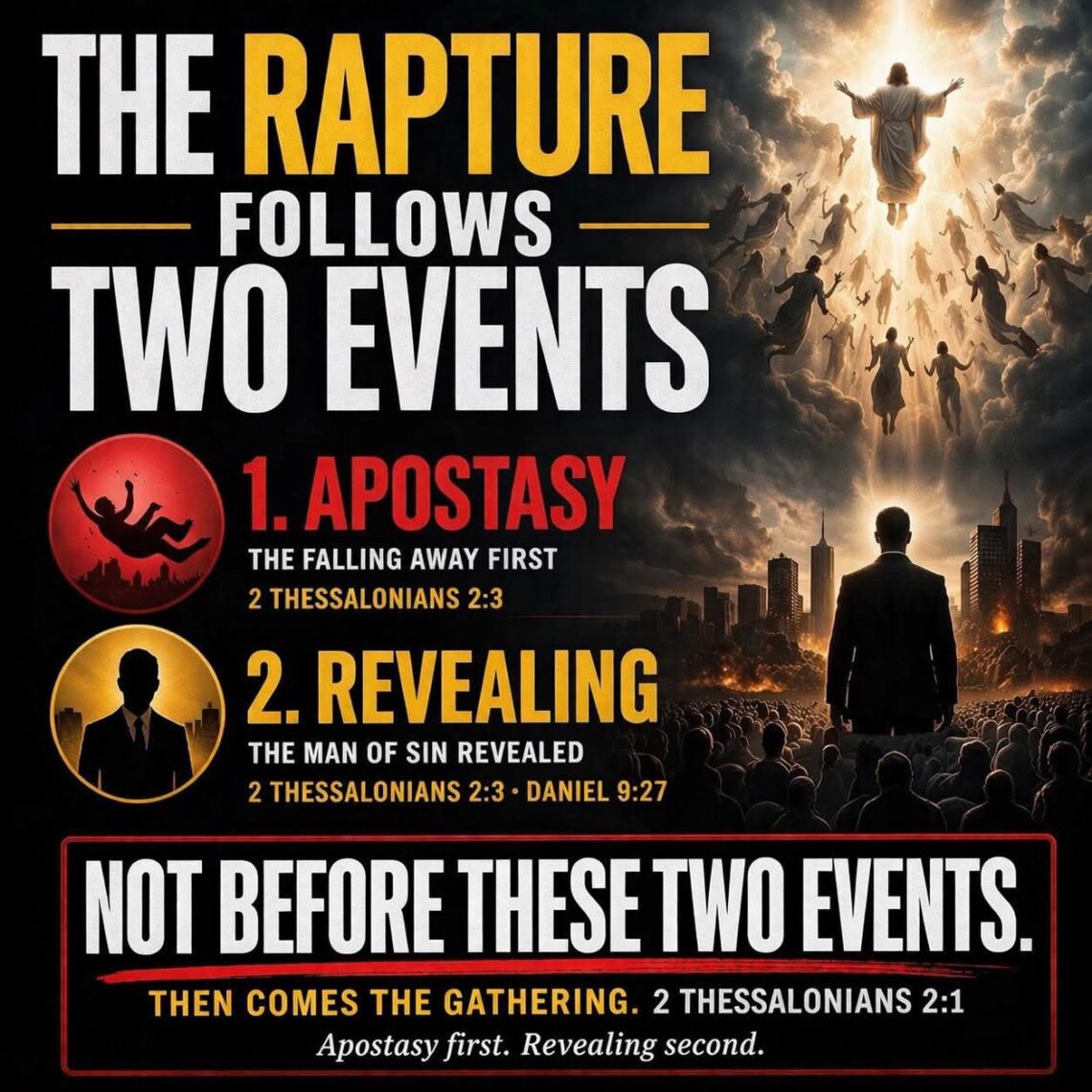
BIBLICAL ENDTIME TIMELINE (part 1)
THE RAPTURE: WHAT DOES SCRIPTURE SHOW WHEN WILL THIS HAPPEN?
This is one of the most debated questions in the church. Pre-trib. Mid-trib. Post-trib. Pre-wrath. Almost everyone already has a position.
But most people did not arrive at that position by carefully working through Scripture. They inherited it from a pastor, a book, or a conference. That does not automatically make it wrong, but it does mean we should be willing to step back and ask a simple question.
What does the text actually say?
So let’s follow the text.
Paul gives the clearest sequence about the gathering of believers in 2 Thessalonians 2:1–3. He wrote this because the Thessalonian church was afraid. They thought they had missed the coming of Yahushua and their gathering to Him.
(Let no man deceive you by any means: for that day shall not come, except there come a falling away first, and that man of sin be revealed, the son of perdition; 2 Th 2:3)
Paul does not respond with vague reassurance. He gives them a sequence so they will not be deceived.
In verse 1, he connects two things: the coming of the Messiah and our gathering together to Him. That is what people commonly call the rapture.
Then in verse 3 he makes it plain. That gathering will not happen until two things happen first.
First, the falling away.
Second, the revealing of the man of sin.
Only after those comes the gathering.
That is not my sequence. That is Paul’s.
So now the question becomes simple. How do the major views fit into that?
The pre-trib view says the church is removed before the tribulation, before the apostasy, and before the man of sin is revealed. But Paul says the gathering does not come until after both the apostasy and the revealing.
If those events happen after the church is gone, then Paul’s warning becomes meaningless to the very people he wrote it to. Why tell believers to watch for signs they would never see?
Paul was writing to the church. He called them brethren. He said our gathering together to Him. He was talking about their gathering, and he told them two things had to happen first.
The post-trib view takes Paul’s sequence seriously. Apostasy first. Revealing second. Gathering after. But it runs into another problem.
Scripture says the church is not appointed to wrath. 1 Thessalonians 5:9 says Yahuah has not appointed us to wrath. Revelation 3:10 says He will keep believers from the hour of trial that is coming on the whole world.
The trumpet and bowl judgments are described as the direct outpouring of God’s wrath. If the church goes through all of that, those promises become difficult to explain.
So one view struggles with Paul’s sequence, and the other struggles with the wrath passages.
This is why many land in what is often called the early tribulation view. It is the only position that holds both together without forcing either one.
Paul says the gathering comes after the apostasy and after the revealing. That means the church is present when the man of sin is revealed.
In verse 3, the revealing is stated. In verse 4, Paul describes what this man does later when he sits in the temple and declares himself to be God. Those are not the same moment. They are separated in time.
So what is the revealing?
Daniel 9:27 describes a leader who confirms a covenant with many for one week, a period of seven years. It is public, it involves Israel and multiple nations, and it marks the beginning of a defined timeline.
That is the moment the man of sin steps into the open. Not at the midpoint, but at the covenant that starts it all.
If that is correct, then the sequence becomes clear.
The church sees the apostasy.
The church sees the revealing.
Then the gathering happens.
But the church is not appointed to wrath, which comes later in the judgments. So the gathering takes place after the revealing, but before the outpouring of Yahuah’s wrath.
After apostasy. After revealing. Before wrath.
That follows the order Paul gave without rearranging it.
If the rapture happens before any of these things, then there is nothing for the church to watch for. But Paul told believers to watch, to discern, and not to be deceived about the timing.
He was writing to ordinary believers who were afraid, and he gave them a sequence so they could understand where they were.
Paul did not give this sequence so it could be ignored. He gave it so it would be recognized.
Apostasy first.
Revealing second.
Gathering third.
The real question is not what position you were taught.
The real question is whether you are willing to follow the text wherever it leads.
Written by: Richard Allinson


You May Also Like

BIBLICAL ENDTIME TIMELINE (part 2)

THE LOST 10 TRIBES
